PolyApiIDE roadmap: Git on disk, a CLI, and MCP are already in progress
I build PolyApiIDE, and I get the same question a lot: where is Git, where is the CLI, where is MCP. Short answer: in progress. Longer answer below — what already covers the job today, ahead of a full release, and what is planned next.
If you are choosing a client right now and "collections as code" or "runs in a pipeline" is a hard requirement today, the decision frame is in the long read, neighbouring extensions are in the Chrome comparison. If you can wait for the release, keep reading.
Git on disk — on the roadmap
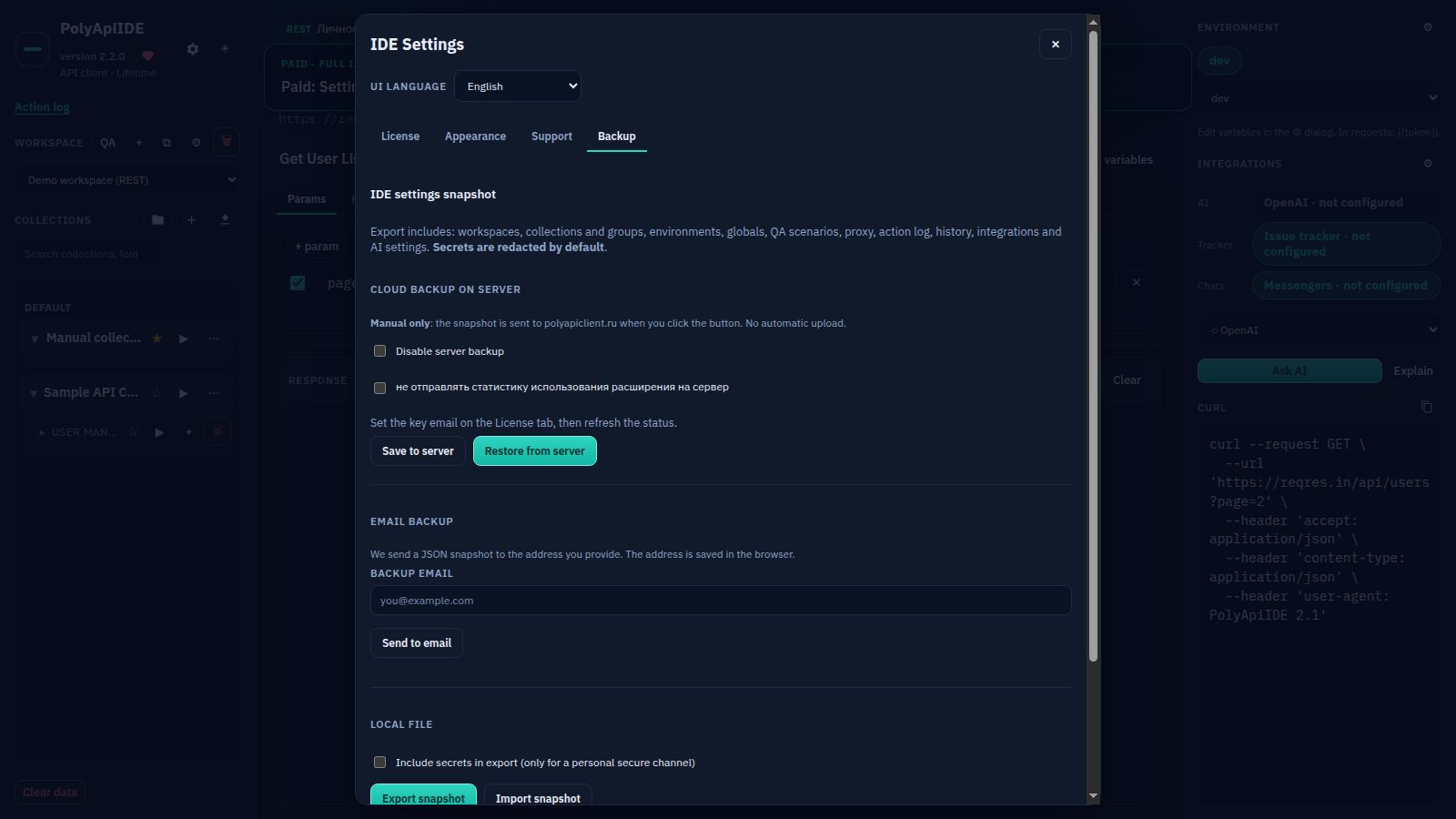
Collections currently live in browser storage, not as .bru files in a repository. Built-in Git support is planned, and we are working on it.
Until it ships, "hand a specific change to someone else" is covered by collection or section patch export and apply on the paid plan — a file with a point-in-time diff and conflict highlighting before you apply it. That does not replace git log or line-by-line review, but it solves the most common case: "here is what I changed, apply it on your end".
If a Git folder on disk is a hard requirement today, Bruno and other git-native clients cover that slot right now. We are heading there, but I will not promise a date in a blog post — watch the product page and the extension's release notes.
CLI for CI — on the roadmap
Running a collection today happens in the tab, by hand or through the built-in runner. A CLI tool callable from GitLab CI or a deploy script is in development.
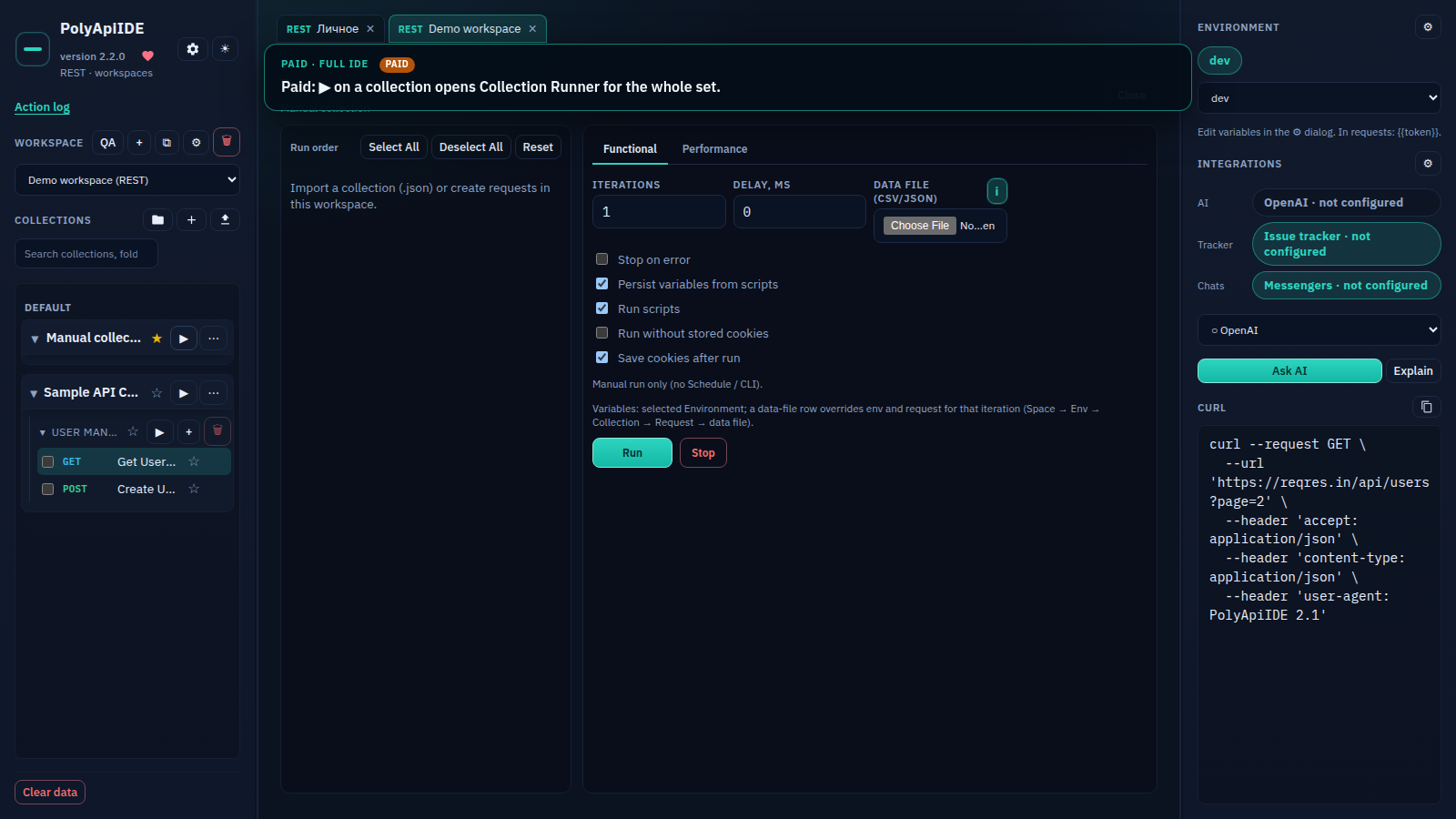
Already available in the tab itself: a functional runner for a collection or folder — iterations, a delay between steps, a CSV/JSON data file, stop on first error. That covers a manual regression pass before a release, but it is not a substitute for an automated pipeline yet.
If you need a green check in CI today, Newman, bru, pytest, and RestAssured remain the right choice until our CLI ships.
An MCP server for editor agents — on the roadmap
An agent in an editor cannot yet call our requests as a tool through MCP. That is also planned — cloud vendors are already announcing their own MCP servers, and we are heading the same direction.
What already exists today is an in-product AI assistant: it explains a response, helps design a collection, and keeps a truncated chat history on the server with no secrets or personal data. That is a useful chat for a human inside the IDE right now, but not yet an MCP tool an external agent can call — that step is ahead of us.
PKCE and full OAuth — on the roadmap
Today, without plugins, Bearer, Basic, API key, a pasted OAuth2 token, JWT, Digest, and AWS signing all work — enough for most internal APIs if you already have the token in hand. A full authorization dance with a redirect, PKCE, and automatic token refresh is the next step, already on the roadmap.
If you need PKCE for Keycloak right now, Postman, Insomnia, and Bruno cover that today — check their current version, not this article.
Native gRPC — on the roadmap
Binary gRPC directly from the tab is planned too. Today there is a gRPC space type built on JSON transcoding: if a service has a JSON gateway, the request goes out like a normal HTTP call. A working workaround for gateway-fronted services, while direct support for the binary protocol is in development.
A shared realtime workspace — on the roadmap
A team today does not sit in one cloud room and does not see each other's cursors in real time — a shared realtime workspace is on the roadmap too, following the sharing tools that already work.
Right now a team exchanges work through collection export, a section patch on the paid plan, opt-in cloud or email backup, and up to five active sessions on one license key — a full breakdown of the team scenario is in the long read. If you need a workspace for twenty people with roles and an audit trail today, that is a job for platforms with per-seat pricing.
What already works today
- a Chrome and Firefox tab from one codebase, no account required to Send;
- on Free: up to three collections, three folders, and one load-test run — enough to tell whether the storage model fits before you pay; environments, variables with inheritance,
pm/polyscripts, OpenAPI, Postman, Insomnia, Hoppscotch, and Thunder import at no extra charge; - CORS bypass via extension permissions — that is the point of living in the browser, not on a separate web domain;
- on the paid plan: request-level QA checks and branching scenarios, negative-scenario generation, a PDF report, task-tracker and messenger integration, load profiles (Fixed/Ramp/Spike/Peak) with metrics export to Grafana/Influx/OpenMetrics, and collection or section patch export;
- up to two active IDE sessions on Free, one on the demo, up to five on paid plans — enough for personal devices and a small team;
- purchase and demo on the site, not an email form inside the extension window; the demo runs for 14 days, once per email.
Lifetime is a one-time payment for the current line; fixes to it are free, and major upgrades to the line are a separate future decision. We do not publish source code, but otherwise the direction is for this list to keep getting shorter over time.
If, after this article, you still want the tab, here is the quick start. If you need a roadmap item right now, use a tool that already has it, and come back once we have shipped it.
The author builds PolyApiIDE. That is stated in the articles, not hidden in a footer.