Chrome extensions for API requests: who is PolyApiIDE's neighbour, and who is doing something else
Desktop clients get compared a lot. Chrome extensions, less often, and usually lumped together as "also in the browser". These are different jobs. Some assemble a request and press Send. Others intercept someone else's traffic. A few are a web app that only needs an extension to get around CORS.
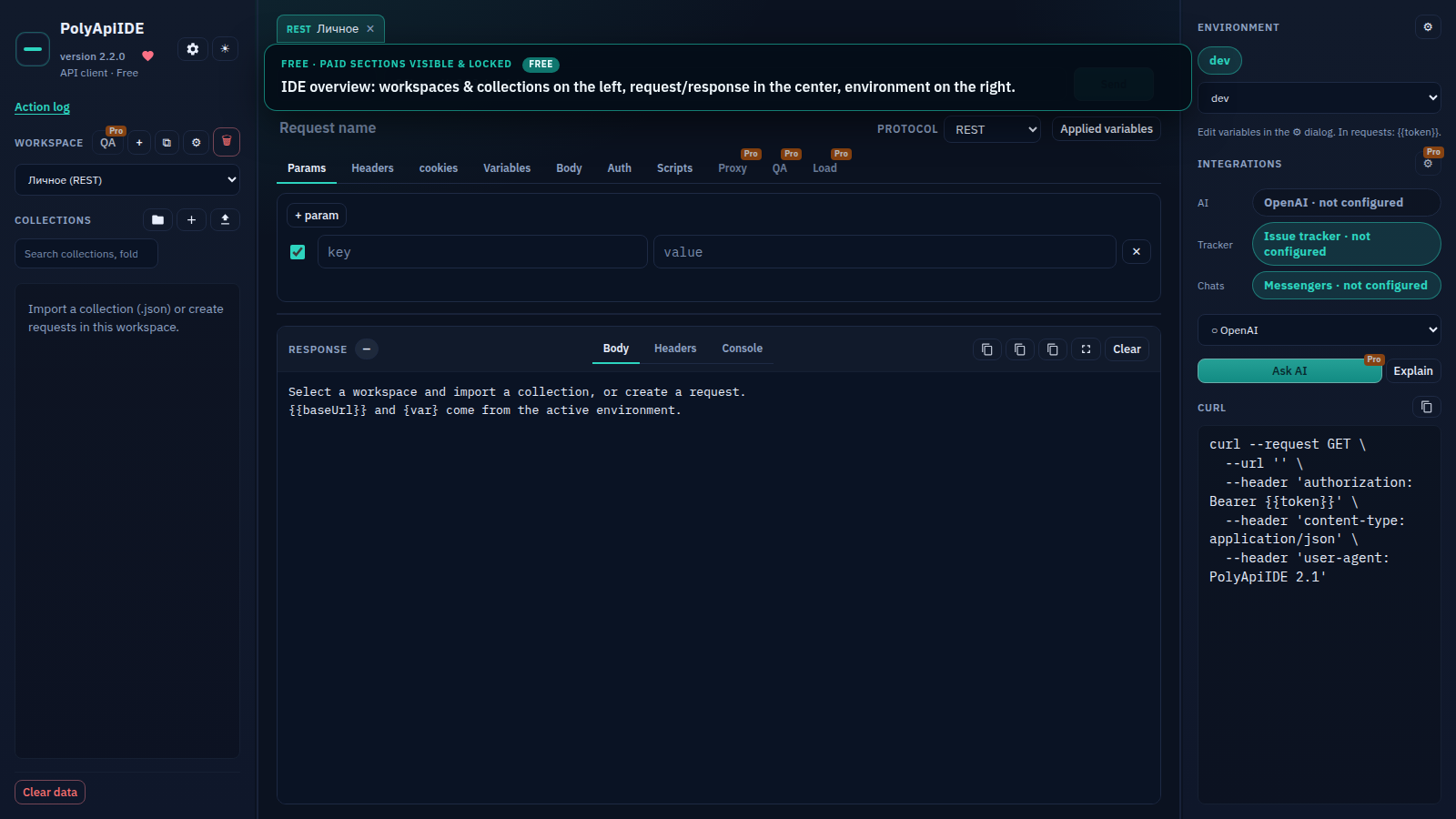
I build PolyApiIDE — the extension that fills the "full API IDE right in a tab" slot: collections, environments, QA scenarios with a report, not just assembling one request. Below: who shares our cell, who is adjacent, and who should not be dragged into the comparison at all. The general "cloud / Git / tab" frame is in the long read.
What counts as "similar"
Similar product: lives in a browser tab or side panel, handles a request collection, environments, headers, body, response history. Not similar: a proxy that "swaps a header on this site", a mock of someone else's frontend, an editor in VS Code.
The criteria I use (not G2 stars — we are not there, and inventing a rating would be pointless):
- do you need an account just to send a request;
- where does the collection live;
- is there a CORS bypass "because it's an extension";
- are there scripts and Postman import;
- is this a client or an interceptor;
- what do you pay, and what do you give up.
Hoppscotch — a neighbour, not a clone
Hoppscotch is a web client. It often ends up in the same table as Bruno, though the slot is different: a browser app, self-hostable if you want, open source. Their extension is a CORS helper and part of some flows, not "the whole IDE in a popup".
Take Hoppscotch if OSS and running your own server matter, and you are fine living with the "web app" model. Do not take it instead of Bruno if your criterion is collection files in a Git PR: that is not their main story.
Hoppscotch is a fairer comparison for PolyApiIDE than Postman is. Both are about the browser. The difference: they are a "web app, optionally self-hosted" product; we are an extension with collections in browser storage, a QA report on the paid plan, and checkout on a Russian site. We have no self-host option, "run your own Hoppscotch". They do not have our bet on "send a report to a tracker from the tab" as the main story.
Talend API Tester
It lived a long time as Restlet, then as Talend API Tester: a full client inside Chrome, collections, environments, a fairly mature interface. For a lot of enterprise QA teams this is "the extension that is already installed".
The weak spot is not the buttons, it is the product's fate: a large vendor, the line has changed hands, and part of the cloud promises depend on the Talend ecosystem, not the tab. If you need a predictable purchase — "a key on a site, no corporate stack" — that is a different channel. If admins have already rolled the extension out, do not migrate just for an article.
We overlap as "a client in Chrome". We do not overlap as "a module of a large integration platform".
Advanced REST Client
ARC is an old Chrome resident, later also a standalone app. Local-leaning, familiar to people who do not want a cloud. The interface and release cadence are an acquired taste; check the current store listing, not a 2018 review.
Slot: a simple client with no heavy QA harness. If a method, a URL, and a body are enough, ARC or even built-in DevTools will do. PolyApiIDE makes sense once you need collections, pm/poly scripts, a run, and a report — not one "URL" field.
Requestly — a different job
Requestly intercepts and rewrites requests made by a page: redirects, mocks, headers, a rule like "swap this on this host". It is a frontend and QA tool with a ready UI, not a replacement for a collection against a backend.
Putting Requestly in a "Postman alternative" table confuses a screwdriver with an oscilloscope. You can use both. You cannot expect environments, collection scripts, and a run report from Requestly the way you would from a client. And you cannot expect us to conveniently "intercept this XHR in prod and swap the JSON" — that is not our slot.
Requestly's real neighbours are ModHeader and DevTools' built-in overrides. Not us.
Thunder Client does not belong here
Thunder Client is a VS Code extension, not a Chrome one. 2026-era reviews keep putting it in the same table as Hoppscotch "because it's also lightweight". The slot is different: you are already in an editor, the collection lives next to the code, the store is the VS Code Marketplace.
If the criterion is "no Electron, but stay in the browser", Thunder is not a candidate. If the criterion is "no second window, I already live in VS Code", it is Thunder / REST Client, not the Chrome store.
Where PolyApiIDE sits
| Criterion | Hoppscotch | Talend API Tester | ARC | Requestly | PolyApiIDE |
|---|---|---|---|---|---|
| Is a collection client | Yes (web) | Yes | Yes | No, an interceptor | Yes |
| Account to Send | Not required locally | Check current policy | Usually no | Not about sending to an API | No |
| Git folder | Not the main slot | No, unlike Bruno | No | No | On the roadmap — collection patches exist today for point-in-time sharing |
| CLI | Not a Newman replacement | Not our focus | No | Different job | On the roadmap — a manual runner with iterations and CSV/JSON data exists today |
| QA report / tracker | Weak | Not a bet | No | No | Scenarios, PDF, tracker and messenger integrations — paid plan |
| Source code | Open | Closed | Own path | Own path | Closed |
What the extension tab buys you, technically
The "Chrome tab" slot is not just "a smaller UI". An extension has host permissions a regular web page does not: a request goes out with the extension's own permissions rather than the site's, so many CORS restrictions that trip up Hoppscotch as a web app without its own helper extension are already lifted for us by default. That is the main reason to keep a client in a tab rather than on a separate web domain of its own.
Next, what "QA report" in the table above actually means. On the free plan you already get collections, environments with variable inheritance, pm/poly scripts, a JSON response tree, and OpenAPI, Postman, Insomnia, Hoppscotch, and Thunder import at no extra charge. On the paid plan: checks right after Send (status, latency, JSON path, fields that look like personal data), branching scenarios, a PDF report per run, and sending a bug to a task tracker or messenger without switching tabs. None of the neighbours in this table cover that whole path: Hoppscotch is closest by browser model but has no equivalent QA chain; Talend API Tester is closest by interface maturity but does not give you independent checkout without a corporate stack.
The same paid plan covers a team scenario too: a collection patch for point-in-time sharing, up to five sessions per key, and sending a bug straight to a tracker or messenger — a full breakdown of team mode is in the long read.
Take X if
- Hoppscotch — you want a web client, ideally your own host, and open source matters more than a tracker report.
- Talend API Tester — the extension is already in the fleet and you do not want to touch the team's habit.
- ARC — you need a simple local client with no harness.
- Requestly — you need to break or mock a page's requests, not build a collection against an API.
- Thunder Client — you are in VS Code; this is not a Chrome-extension comparison.
- PolyApiIDE — you want a full API IDE in a Chrome/Firefox tab: collections and scripts with no account, import for every popular format, QA scenarios with a PDF report, and checkout on a Russian site. Git folder, CLI, and MCP are on the roadmap — details in the roadmap post.
Try it: quick start or the Chrome store. Purchase — on the site, not inside the extension window. Firefox is built from the same codebase.
The author builds PolyApiIDE. That is stated in the articles, not hidden in a footer.